BMW 320d Engine Failure: Costs at 100,000 Miles
BMW 320d Engine Failure: Costs at 100,000 Miles
- October 6, 2026
Published: 6 October 2026 | Last updated: 6 October 2026
Author: Evie Parker
Role: Automotive Content Writer
Reviewed by: BMW Engine & Gearbox Specialists
Published by: BMW Engines & Gearboxes
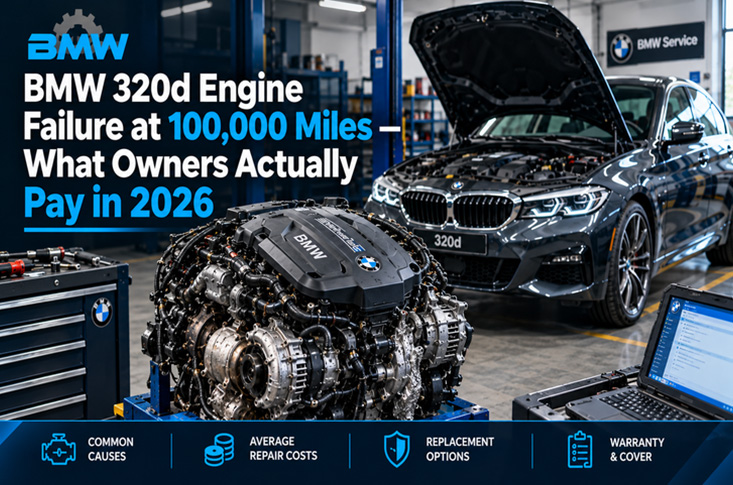
BMW 320d Engine Failure at 100,000 Miles: Real 2026 Prices for Used, Reconditioned and Replacement 320d Engines, and How to Avoid Paying Twice
Quick answer for BMW 320d owners: In the UK automotive repair market, a 320d at 100,000 miles is usually worth repairing when diagnostics confirm a contained timing-chain, injector, turbo, EGR or DPF fault. Choose engine replacement only when compression, oil-pressure and internal inspection results confirm serious crank, bore, block or valve damage. Typical fitted costs in this guide are £2,600–£4,000 for a used engine and £3,800–£4,600 for a reconditioned unit.
Audience and use cases: This UK automotive guide is for BMW 320d owners responding to warning signs or engine failure, used-car buyers assessing a replacement-engine vehicle, fleet operators comparing repair cost and downtime, and independent garages advising customers. Use it when deciding whether to authorise a repair, select a used or reconditioned engine, compare workshop quotations, verify warranty paperwork, or buy a high-mileage BMW 320d.
Summary: repair or replace a BMW 320d engine?
Bottom line: Start with recorded fault codes, hot oil pressure, injector leak-off data and compression testing where symptoms justify it. Repair is the lower-cost route when the bottom end and bores are sound; replacement is the safer decision when measurement confirms internal mechanical damage. The cost table and examples below help owners, buyers, fleets and garages compare those options consistently.
What the job costs in 2026
| Route | Fitted cost | Cover |
| Used N47D20 engine | £2,600–£3,600 | 30–90 days |
| Used B47D20 engine | £3,000–£4,000 | 30–90 days |
| Reconditioned N47 or B47 | £3,800–£4,600 | 12 months written |
| Chain repair only | £900–£1,600 | 12 months typical |
| Dealer exchange | £5,500+ | Dealer terms |
Why 100,000 miles is the decision point
At this mileage, a car fitted with a used BMW 320d Engine has usually finished depreciating, so the engine is a repair rather than a write-off decision. It is also the mileage at which timing chain wear, injector wear and turbo wear appear together, which is why a proper diagnosis matters more here than at any other point in the car's life.
What fails first on a 320d?
Short answer: Timing-chain wear usually appears first, followed by injector and turbo wear, while EGR and DPF issues often develop alongside them on short-journey cars. A car that has had short oil intervals and long journeys often reaches 150,000 miles without a chain problem; a town-driven car with long intervals may show the first rattle at 70,000.
What should the diagnosis include before you spend?
- Fault codes read and recorded, not cleared.
- Chain condition and cam correlation data.
- Hot oil pressure reading.
- Injector leak-off rates.
- Turbo shaft play and oil feed condition.
- Compression test if smoke or roughness is present.
When does repair beat replacement?
Short answer: Repair usually beats replacement when the fault is contained: a chain rattle with no valve damage, injector wear with clean bores, a turbo failure with a sound bottom end, or an EGR and DPF issue. Each costs well under half of a replacement engine.
When does replacement become unavoidable?
Short answer: Replacement becomes unavoidable when there is metal debris in the sump, the chain has jumped and valves have contacted pistons, oil pressure is low with a knock, or the crank or block is damaged. Those findings should be confirmed by measurement before an engine is ordered.
How do you avoid paying twice?
- Fix the cause as well as the engine: oil feed, cooling, EGR and DPF.
- Renew the timing components with any replacement engine.
- Renew injector seals and check leak-off rates.
- Replace the turbo oil feed pipe where a turbo has failed.
- Keep the warranty paperwork and follow the oil intervals.
What does a 320d replacement involve?
Engine out from above with the gearbox separated, ancillaries inspected and transferred, new timing components and seals, fresh oil and coolant of the correct specification, then coding, adaptation and a road test with a fault-code read. Three to six days for a used engine, one to three weeks for a reconditioned unit.
What should the invoice show?
Engine code and number, parts replaced, timing components renewed, mileage at fitting, warranty duration and mileage cap, and the disposal or core exchange terms. On a 320d, the paperwork is what protects the value of the car and your position if the engine fails inside warranty.
Frequently asked questions
Is a 320d worth an engine at 100,000 miles?
Short answer: Usually yes, provided the car has good bodywork, a sound gearbox and service history. A warrantied replacement keeps a car that has already absorbed most of its depreciation.
How much is a reconditioned 320d engine fitted?
A reconditioned BMW engine for a 320d typically costs £3,800–£4,600 fitted at specialist rates, with a twelve-month written warranty.
Can I just replace the chain and keep driving?
Yes, if the chain has not failed and no valve damage has occurred. Once it has jumped, the repair becomes a head or engine job.
Should I buy a 320d with a replaced engine?
When buying a BMW 320d, documentation and a live warranty can make it safer than an untouched car with unknown history.
How long does the job take?
Three to six days for a used engine and one to three weeks for a reconditioned one.
What does the first 500 miles after a 320d engine change look like?
Gentle driving, daily oil and coolant checks for the first week, an oil and filter change at 500 miles, and a fault-code read. On a BMW diesel that routine catches the rare installation problem while the warranty is live, and it costs about £150 in total.
Which 320d faults are worth repairing rather than replacing the engine?
- Chain rattle caught before failure — repair.
- Turbo failure with a sound bottom end — repair.
- Injector wear with clean bores — repair.
- EGR and DPF blockage — clean or replace.
- Swirl flap wear on high-mileage engines — repair.
Replacement applies to crank, bore or block damage, or to a chain failure that has already bent valves. Everything above the line is a repair, and repairs preserve your original engine number.
Worked example: using diagnosis and cost benchmarks
Example decision: If a 100,000-mile 320d has chain rattle but normal hot oil pressure, clean compression results and no metal debris, the £900–£1,600 chain-repair benchmark is materially lower than the £2,600–£4,600 fitted engine options. If testing instead finds low oil pressure, metal debris or valve contact after a jumped chain, replacement becomes the defensible route. This is a diagnostic example based on the benchmarks in this guide, not a customer testimonial.
What should a buyer check on a 320d with a replaced engine?
- Invoice with the engine number and code.
- Warranty certificate with a mileage cap.
- Evidence of timing components being renewed.
- Oil change history at short intervals since the work.
- A cold start witnessed from stone cold, followed by a GOV.UK MOT history check for mileage and recurring advisories.
Does a replaced engine affect the value of a 320d?
Documented work with a warranty usually protects value, because buyers of these cars are wary of exactly this fault. What harms value is silence: a car with no paperwork and a rebuilt engine raises a question the buyer cannot answer, and they discount accordingly.
What is the realistic annual running cost of a 320d after a replacement?
| Item | Typical annual cost |
| Oil and filter service | £180–£320 |
| Coolant and system check | £80–£150 |
| DPF and EGR attention | £200–£600 when needed |
| Brakes, tyres and suspension | Vehicle dependent |
| Diagnostic health check | £80–£150 |
Budget those figures and a repaired 320d is a manageable car to run. Ignore them and the engine work you have just paid for may be repeated sooner than you expect.
What is the one-line answer on a 320d at 100,000 miles?
Diagnose with codes, compression and oil pressure before you decide anything; four of the five common faults are repairs, and only a proper measurement separates them from an engine replacement.
Does the 320d replacement need the gearbox looking at?
On a manual car with over 100,000 miles and the gearbox already out, a clutch and flywheel is sensible. On a ZF automatic, ask about a fluid service while the car is in the workshop. For BMW engine and gearboxes, both checks are cheap against the labour already being paid, and both protect the rest of the car.
How do I know if the replacement engine was fitted correctly?
Ask for the fault-code readout before and after, the oil and coolant specification used, the road test notes and the warranty certificate. On a 320d, a proper installation is documented rather than described, and that documentation protects both you and the value of the car.
What is the realistic life of a reconditioned 320d engine?
With short oil intervals, correct specification oil and sensible journeys, 120,000 to 150,000 miles is achievable. Neglect the servicing and the same engine will develop chain rattle and injector wear all over again, which is precisely why we schedule the first oil change at 500 miles and check the codes with it.
Want to read or learn more about BMW engine?
- Why Reconditioned BMW 730d Engines Are a Viable Option?
- Second Hand Success: My Expert Tips on Finding a Reliable Replacement BMW 325d Engine Near You
- BMW 535d Engine Replacement Cost Explained: Real Quotes for Supply & Fit Across the UK
- Does Installing a Rebuilt BMW 116d Engine Impact Your Insurance Policy?
Categories
- Automotive News
- BMW
- saloon
- BMW 316d
- 7 series
- BMW 120d
- BMW 535d
- BMW 318d
- BMW 730D
- Bmw 530d
- BMW X6
- BMW 116i
- BMW 320d
- BMW M5
- BMW 5-Series
- BMW 325d
- SUV
- BMW 118D
- 1-series
- BMW 6-Series
- BMW 320i
- bmw 1 series
- BMW Mini
- BMW 116d
- Bmw Z series
- BMW X SERIES
- BMW 3-Series
- BMW 325
- BMW NEWS
- BMW 318i
- BMW i8
- BMW 330ci
- BMW engine
- BMW M power
- BMW 635d
- BMW 335d