BMW 530d and X5 N57 Engine Faults, Symptoms & Repair Costs
BMW 530d and X5 N57 Engine Faults, Symptoms & Repair Costs
- October 10, 2026
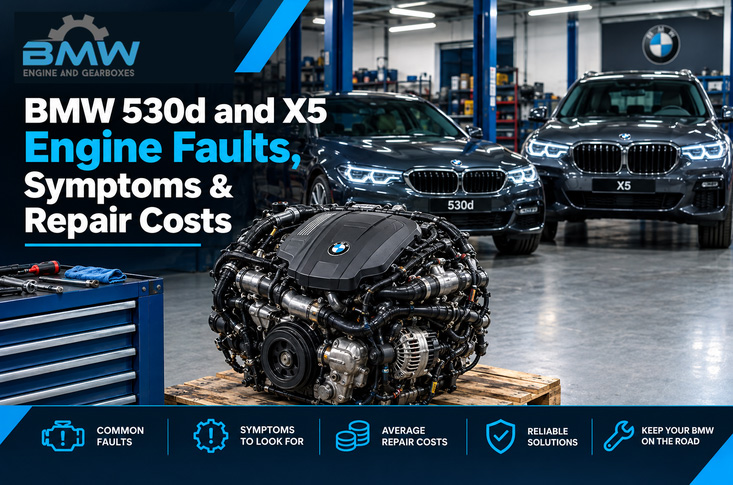
BMW 530d, 535d or X5 Engine Failure: What the N57 3.0 Diesel Actually Costs to Repair or Replace in the UK
Summary: For UK BMW 530d, 535d and X5 3.0d owners, buyers and independent workshops, early N57 timing-chain, injector, turbo or EGR faults are often repairable. If the chain has failed or the crank, block, valves or pistons are damaged, a used or reconditioned replacement engine is usually the more practical decision. Typical fitted UK costs range from £2,800 to £6,500.
Who this guide is for: UK BMW 530d, 535d and X5 3.0d owners, used-car buyers, independent garages and engine specialists deciding whether N57 symptoms justify diagnosis, component repair, a used engine or a reconditioned replacement.
Last updated: 10 October 2026.
What you are looking at, in numbers
An N57 failure is expensive because the engine is large and the labour is substantial. Realistic UK figures: £2,800–£4,400 fitted for a used BMW 530d engine, £4,400–£6,500 for reconditioned BMW engines based on the N57, and £7,000+ for a replacement BMW engine through a franchised dealer.
Which N57 faults should you expect?
| Fault | Symptoms | Route |
| Timing chain wear | Cold rattle, cam codes | Chain replacement |
| Swirl flap failure | Limp mode, poor economy | Inlet repair |
| Injector wear | Rough running, smoke | Injector set |
| Turbo failure | Whistle, smoke, boost loss | Turbo replacement |
| EGR cooler cracks | Coolant loss, white smoke | Cooler replacement |
What does each repair cost?
| Job | Cost |
| Chain, guides and tensioner | £1,600–£3,200 |
| Swirl flap and inlet repair | £900–£1,800 |
| Injector set and coding | £1,200–£2,400 |
| Turbo replacement | £1,200–£2,400 |
| Reconditioned N57 fitted | £4,400–£6,500 |
Why does the N57 fail earlier in some cars?
Short answer: The N57 fails earlier in cars exposed to short journeys, heavy loads, extended oil intervals, and incomplete DPF regeneration. A 530d that spends its life on motorways can last far longer than an X5 used for short journeys with a heavy load. The oil never reaches temperature, the EGR and DPF load up, and the timing components wear faster. The engine is the same; the use is not.
What should the diagnosis include?
- Fault codes read and recorded.
- Chain condition assessed.
- Live data on boost and rail pressure.
- Injector leak-off rates.
- EGR and DPF condition checked.
When is repair the right answer?
Short answer: Repair is the right choice when the fault is limited to one system and the engine’s core internals remain sound. When the fault is confined to one system—a swirl flap repair, an injector set, a turbo, an EGR cooler or a timing chain that has not yet failed—specialists in BMW engines and gearboxes can often repair the affected system for a fraction of the cost of a replacement engine.
When is replacement the only answer?
Short answer: Replacement is usually the better option once internal damage is extensive or several major systems have failed together. This applies when the chain has failed with valve damage, when the crank or block is damaged, or when two or more major systems have failed together on a high-mileage car. At that point the arithmetic favours an exchange engine or an honest conversation about the car's future.
How do you protect an N57 after repair?
- Oil and filter every 6,000–8,000 miles.
- Regular longer runs to keep the EGR and DPF healthy.
- Correct specification oil.
- Investigate any rattle or boost fault immediately.
- Keep the invoice and warranty paperwork.
Real N57 Fault Scenarios: Repair or Replace?
Scenario 1: Cold-start rattle but no internal damage
A 530d develops a brief metallic rattle on cold start, but it still runs smoothly and diagnostic checks show no valve or piston damage. In this case, replacing the timing chain, guides and tensioner for roughly £1,600–£3,200 is usually more sensible than replacing the complete engine. Acting early prevents a repairable warning sign from becoming a major N57 engine failure.
Scenario 2: Chain failure with valve damage
An X5 3.0d stops after the timing chain fails and compression testing confirms damaged valves. Once cylinder-head work, labour and additional worn components are included, a used or reconditioned N57 engine may offer better value and a clearer warranty than rebuilding the damaged unit piece by piece.
Scenario 3: Turbo smoke with healthy engine internals
A 530d loses boost and produces blue smoke, but oil pressure, compression and injector readings remain acceptable. A turbo replacement and a careful check of the oil feed, intercooler and DPF can solve the fault without an engine swap. This is why diagnosis should come before choosing the most expensive route.
Frequently asked questions
Is the N57 a reliable engine?
Generally yes, with the caveats of duty cycle and servicing. Short-journey use and long oil intervals are what shorten its life.
How much is a replacement 530d engine?
£2,800–£4,400 fitted for a used N57 and £4,400–£6,500 for a reconditioned one.
Can I fit an N57 from a different model?
Only with matching ancillaries, mounts and software. Confirm the code against your VIN.
Should I repair or replace after a chain failure?
If the valves and pistons have met, replacement is usually the better commercial decision. If the chain is caught early, repair it.
How long does the work take?
Three to seven days for repairs and two to four weeks for a reconditioned engine.
Detailed N57 Ownership and Replacement Guidance
What does a full N57 diagnosis cost, and what does it include?
Short answer: A full N57 diagnostic session typically costs £150–£300. It should include engine codes, live data on boost and rail pressure, injector leak-off rates, a chain assessment and a cooling system pressure test. On a large diesel, that session is what separates a repair from an engine replacement, and it is the best value in the entire process.
Which N57 fault costs owners the most overall?
Short answer: A failed timing chain is usually the most expensive N57 fault because it can damage the cylinder head and other components. A £1,600 chain repair can become a £4,400–£6,500 engine replacement, and the difference is largely determined by how early the rattle is investigated.
How does mileage alone mislead N57 buyers?
A 530d at 120,000 motorway miles can be in far better condition than an X5 at 70,000 miles used for school runs and short tows. Duty cycle determines oil temperature, EGR loading and DPF cycles, and those determine engine life far more than the number on the dashboard. Buyers should also review the car’s GOV.UK MOT history for recurring emissions issues or mileage inconsistencies.
What should a buyer check before purchasing an N57 car?
- Full service history with short oil intervals.
- Cold start from stone cold, bonnet open.
- Fault codes read for timing, boost and emissions.
- EGR cooler and DPF condition assessed.
- Any record of swirl flap or chain work.
How do you compare an independent replacement with a dealer engine?
Line up the price, the warranty and the documentation. An independent specialist usually beats dealer pricing significantly, and a reconditioned unit with a twelve-month written warranty often provides better cover than a dealer exchange with a shorter term. What differs is the badge and, sometimes, the convenience.
What is the biggest risk after an N57 replacement?
Fitting an engine without addressing the reason the original failed. If the EGR cooler, cooling system or injectors caused the damage, those components must be corrected with the new engine, and any workshop that ignores them is setting up a repeat failure.
How do you compare a repair quote with a replacement quote?
Line them up on scope: what exactly is being replaced or repaired, what is being checked while the engine is out, and what the warranty covers. A repair quote that includes chain, seals and cooling checks may be better value than a replacement quote that does not, and the totals only mean something once the scope is on the page.
What is the single biggest mistake N57 owners make?
Driving on after a cold rattle. On a three-litre diesel the chain damage progresses quickly, and the difference between a chain repair and an engine replacement is often a matter of weeks. Every owner we have asked says the same thing afterwards: they thought it would be fine for a bit longer.
How do you protect the value of a 530d or X5 after engine work?
Keep the invoice, the warranty certificate and the engine number, and mention the work honestly in any advert. Buyers of these cars are wary of engine work that is not documented, and a complete file turns a potential worry into a selling point.
What does an N57 replacement involve on a 5 Series?
Front-end dismantling for access, engine out from above with the gearbox separated, ancillaries inspected and transferred, new timing components, seals and fluids, then coding and a road test. Three to seven days for a used engine in stock, and two to four weeks for a reconditioned unit that has to be built or delivered.
How much does an N57 repair cost compared with replacement?
| Route | Cost | Right when |
| Swirl flap and inlet repair | £900–£1,800 | Limp mode without bottom-end damage |
| Injector set and coding | £1,200–£2,400 | Rough running with clean bores |
| Turbo replacement | £1,200–£2,400 | Boost loss with sound internals |
| Chain, guides and tensioner | £1,600–£3,200 | Rattle caught before failure |
| Reconditioned engine fitted | £4,400–£6,500 | Bottom-end damage |
| Used engine fitted | £2,800–£4,400 | Older car, shorter ownership |
What should the buyer of an N57 car look for?
- Service history with short oil intervals rather than the long schedule.
- Evidence of EGR cooler, swirl flap or chain work, if any.
- Cold start witnessed from stone cold.
- Fault codes read before money changes hands.
- A compression test if any smoke or roughness is present.
What does the N57 sound like when the chain is going?
A brief rattle for a second or two on cold start that disappears as oil pressure builds, sometimes a light metallic tick at idle when hot, and occasionally a cam correlation fault stored without any obvious symptom. The absence of drama is what makes it dangerous, because owners wait for something worse to happen and it does.
Does an N57 replacement need new injectors?
Not always, but they should be leak-off tested and the seals renewed. On a high-mileage three-litre diesel, injector wear is common, and fitting a replacement engine with tired injectors simply transfers the problem onto new metal.
Should a 530d owner replace the engine or the car?
Run the numbers honestly: value the car in working order, subtract the fitted engine cost, and compare with what the car would fetch with the fault disclosed. On a well-kept car with history, the engine usually wins; on a tired example with several faults, the car wins.
Want to read or learn more about BMW engines?
- Is That Cold-Start Rattle Hiding a £4,000 Bill? BMW Engine Replacement UK Explained
- BMW 120d Before and After Engine Swap: Lessons from a Costly UK Fix
Categories
- Automotive News
- BMW
- saloon
- BMW 316d
- 7 series
- BMW 120d
- BMW 535d
- BMW 318d
- BMW 730D
- Bmw 530d
- BMW X6
- BMW 116i
- BMW 320d
- BMW M5
- BMW 5-Series
- BMW 325d
- SUV
- BMW 118D
- 1-series
- BMW 6-Series
- BMW 320i
- bmw 1 series
- BMW Mini
- BMW 116d
- Bmw Z series
- BMW X SERIES
- BMW 3-Series
- BMW 325
- BMW NEWS
- BMW 318i
- BMW i8
- BMW 330ci
- BMW engine
- BMW M power
- BMW 635d
- BMW 335d