BMW X1 or X3 B47 Engine Problems — EGR, Timing and What It Costs
BMW X1 or X3 B47 Engine Problems — EGR, Timing and What It Costs
- October 13, 2026
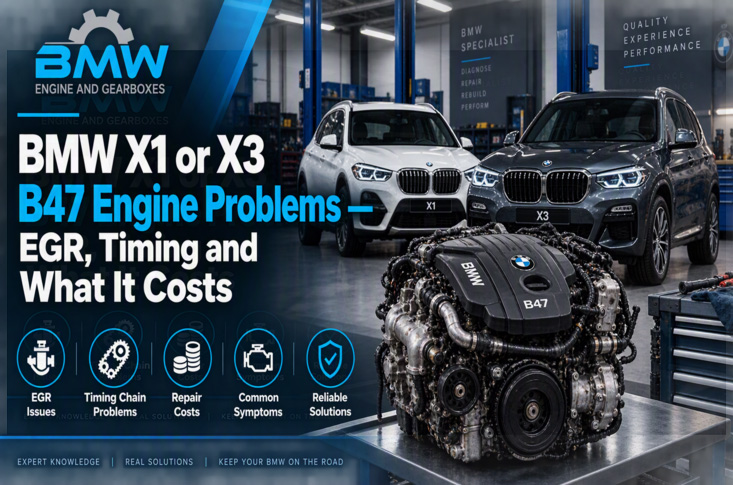
BMW X1 or X3 B47 Diesel Problems: The EGR Cooler Fault, Timing Wear, and What a Replacement BMW Engine Actually Costs
Author and editorial ownership
Author: Evie Parker | Editorial responsibility: BMW engine repair and replacement guidance | Last reviewed and updated: 13 October 2026
Summary: This guide is for UK BMW X1 and X3 owners, used-car buyers and automotive repair customers dealing with a B47 diesel fault. The main answer is to diagnose coolant loss, white smoke, timing noise or warning lights early: common repairs typically cost £400–£1,800, while a fitted used or reconditioned B47 replacement usually costs £3,000–£4,600.
Key takeaway: Do not ignore coolant loss, white smoke, cold-start rattles or warning lights. A prompt pressure test and fault-code check can turn a manageable repair into savings of several thousand pounds by preventing major engine damage.
Who this BMW B47 guide is for and when to use it
Audience: UK BMW X1 and X3 B47 diesel owners, used-car buyers, independent garages and automotive engine-repair customers. Use cases: diagnosing coolant loss, white smoke, timing noise, DPF or injector faults; checking a used vehicle or engine; and comparing repair, used-engine and reconditioned-engine quotes. Decision context: use this guide to decide whether the car is safe to drive, whether a fault is repairable, and whether repair or full engine replacement offers better long-term value.
What goes wrong on a B47
The B47 is a better engine than the N47 it replaced, with a revised timing drive, but it has its own known issues. The most common are EGR cooler cracking, timing chain wear on neglected examples, and injector wear at higher mileages. All three are manageable if they are caught, and all three are expensive if they are not.
The faults, and what they cost
| Fault | Symptoms | Cost to repair |
| EGR cooler cracking | Coolant loss, white smoke | £700–£1,400 |
| Timing chain wear | Cold rattle, cam codes | £900–£1,600 |
| Injector wear | Rough idle, smoke, economy loss | £800–£1,600 |
| Turbo failure | Whistle, boost loss, smoke | £900–£1,800 |
| DPF blockage | Limp mode, regeneration faults | £400–£1,200 |
Why the EGR cooler matters on X1 and X3 models
Short answer: The EGR cooler matters because a crack can allow coolant into the intake and cause hydraulic lock. X1 and X3 models are often used for shorter journeys than their larger siblings, so the EGR system works harder and the cooler is more likely to crack. Coolant entering the intake is damaging and can destroy an engine quickly, which is why coolant loss on a B47 should be treated as urgent rather than routine.
What should the diagnosis include?
Short answer: A proper B47 diagnosis should combine fault-code scanning, cooling-system pressure testing and live-data checks before any repair or replacement is recommended.
- Fault codes read and recorded.
- Cooling system pressure tested.
- Live data on EGR, boost and rail pressure.
- Injector leak-off rates checked.
- DPF differential pressure measured.
- Chain assessed through the available access.
When is a replacement engine the right answer?
Short answer: Replace the engine when the block, crank or cylinder head is seriously damaged—typically after hydraulic lock, timing-chain failure with valve contact or oil starvation. Outside those cases, the B47 is usually repairable, and repair is significantly cheaper than replacement. For severe damage, specialist BMW engines and gearboxes services can help confirm which option offers better value.
What do replacements cost?
Short answer: Expect £3,000–£4,000 fitted for a used B47 or £3,800–£4,600 for a reconditioned unit; dealer exchange engines can exceed £5,500.
| Route | Fitted cost |
| Used B47 engine | £3,000–£4,000 |
| Reconditioned B47 engine | £3,800–£4,600 |
| Short engine | £3,200–£4,200 |
| Dealer exchange | £5,500+ |
How do you protect a B47 after repair?
Short answer: Use the correct oil, service it every 6,000–8,000 miles, check coolant monthly and investigate any coolant loss or warning light immediately.
- Oil and filter every 6,000–8,000 miles.
- Coolant level and strength checked monthly.
- Longer runs weekly to keep the EGR and DPF healthy.
- Any coolant loss investigated immediately.
- Correct specification oil only.
How do you check a used BMW X3 engine before buying?
Before purchasing a used BMW X3 engine or a complete vehicle, verify its service history and carry out the following checks.
- Coolant level and condition, checked cold.
- Cold start observed, listening for chain rattle.
- Fault codes read, particularly EGR and coolant-related.
- Service history showing short oil intervals.
- Any record of EGR cooler replacement, which is a positive sign.
What does a B47 replacement involve?
Engine out from above with the gearbox separated, cooling pack moved and the loom disconnected and labelled. Three to seven days for a used engine, two to four weeks for a reconditioned unit, followed by coding, adaptation and a road test with a fault-code read.
What should the invoice and warranty show?
Engine code, engine number, parts replaced, timing components renewed, mileage at fitting, and a warranty with a duration and mileage cap. On a B47, confirm specifically that the EGR and cooling systems were assessed, because those are the faults that caused most of the engines we replace.
Frequently asked questions
Is the B47 a good engine?
Yes, generally. It is a significant improvement on the N47, though it has its own EGR cooling fault that owners should know about.
How much is a replacement X3 engine?
£3,000–£4,000 fitted for a used B47 and £3,800–£4,600 for a reconditioned one. A properly Rebuilt BMW X3 Engine may cost more initially, but it can offer better long-term value when the work and warranty are fully documented.
Can a cracked EGR cooler destroy the engine?
Yes, if coolant enters the cylinder in quantity. It is the most urgent fault on this engine and should be repaired on diagnosis.
Is the timing chain still a concern on the B47?
Less than on the N47, but it still needs short oil intervals and prompt attention to any cold rattle.
How long does the work take?
Three to seven days for repairs and two to four weeks for a reconditioned engine.
What does a B47 EGR cooler failure cost in total?
£700–£1,400 for the cooler and associated work, plus whatever damage the coolant has already caused. If coolant has entered the cylinder in quantity, you are looking at hydraulic lock and an engine, which is why we treat coolant loss on this engine as a same-week problem rather than something to monitor.
How do you check for an EGR cooler fault before it becomes serious?
- Coolant level checked cold, weekly.
- Coolant pressure test at service.
- Fault codes scanned for EGR and coolant-related faults.
- White smoke from the exhaust observed and investigated.
- Coolant contamination of the oil checked for.
Should I buy an X3 with a replaced EGR cooler?
Yes, and it is a positive sign. A documented cooler replacement with a warranty means the most common failure on this engine has been addressed, and it is money the previous owner spent that you do not have to.
What does a B47 engine replacement cost all in?
£3,000–£4,000 fitted for a used unit, £3,800–£4,600 for a reconditioned one, plus any ancillary work required. Compare that with a repairable fault at £700–£1,600, and the case for diagnosing early rather than replacing is obvious.
How do you keep a B47 out of trouble long term?
Short oil intervals, monthly coolant checks, weekly longer runs and immediate attention to any warning light. Those four habits cost little and they are the reason some B47 engines reach 180,000 miles while others need work at 70,000.
What does a B47 replacement cost on an X3?
£3,000–£4,000 fitted for a used unit and £3,800–£4,600 for a reconditioned one at specialist rates, plus any ancillary work identified during the job. Compare that with £700–£1,600 for the most common B47 repairs, and the case for diagnosing early is obvious.
What does a B47 EGR cooler replacement involve?
Cooler removed, cooling system flushed, new cooler and gaskets fitted, system pressure tested and refilled with the correct coolant. It is a day's work on most X1 and X3 models, and it is far cheaper than the engine damage that a delayed repair can cause.
How does the B47 compare with the N47 for buyers?
| Factor | N47 | B47 |
| Timing chain risk | Higher | Lower |
| EGR cooler risk | Lower | Known fault |
| Injector wear | At high mileage | At high mileage |
| Used engine price | £2,600–£3,600 | £3,000–£4,000 |
| Our recommendation | Good with history | Better long-term buy |
What should a B47 owner do at every service?
Ask for a coolant pressure test, a fault-code read and a visual check of the EGR cooler area. Those three items take minutes and they detect the fault that causes most of the engine replacements we carry out on this engine.
What else should be checked while a B47 engine is out?
- EGR cooler and pipework, because it is the known fault.
- Intercooler for oil contamination.
- Turbo oil feed and return.
- Cooling system pressure tested as a whole.
- DPF loading and differential pressure.
- Injector leak-off rates on all four.
Those checks cost little while the engine is out and can prevent a repeat failure in the following year. Any workshop that skips them has not understood why these engines fail.
Which B47 symptoms require immediate action?
Stop driving and arrange diagnosis if the engine is losing coolant, producing persistent white smoke, rattling heavily on a cold start, showing low oil pressure or entering limp mode repeatedly. A minor warning light with normal coolant, oil level and engine behaviour may allow a careful trip to a workshop, but it should not be ignored. The decision depends on whether the symptom points to possible internal damage rather than simply how well the car still drives.
What is a practical B47 repair example?
Example: An X3 owner notices a small weekly coolant drop but no overheating. A pressure test identifies an EGR cooler leak before coolant reaches a cylinder, so the cooler can be replaced within the typical £700–£1,400 repair range. Delaying the same diagnosis could allow hydraulic lock and turn a repairable fault into a £3,000–£4,600 engine replacement. This is why symptom timing matters as much as mileage.
How should owners decide between repair and replacement?
Repair is usually best when testing confirms a contained EGR, injector, turbo, DPF or timing fault and the block, crank and cylinder head remain serviceable. Replacement is more sensible after hydraulic lock, severe oil starvation, valve contact or damage that makes the combined parts and labour cost approach the price of a warranted engine. Owners should compare the written diagnosis, total fitted price, warranty cover and intended ownership period before deciding.
Related questions about BMW B47 ownership
Can short journeys increase B47 problems?
Yes. Repeated short trips create more heat cycles and give the DPF fewer opportunities to regenerate fully, so EGR and DPF-related issues deserve closer monitoring.
Is mileage alone enough to judge a used B47?
No. Service intervals, coolant history, cold-start behaviour, fault codes and evidence of EGR cooler work are more useful than mileage alone.
What documents matter after an engine replacement?
Keep the fitted invoice, engine code and number, mileage record, parts list, warranty terms and evidence that the cooling, EGR, turbo and DPF systems were checked.
How do you compare a used B47 with a reconditioned one?
Line up the price, the warranty and the preparation. A used B47 at £3,000–£4,000 fitted suits a car you may sell within a year. A reconditioned unit at £3,800–£4,600, with new bearings, seals and timing components plus a twelve-month warranty, suits a car you intend to keep for years. Buyers comparing reconditioned BMW engines should check exactly which internal components have been renewed. The gap is around £600 to £1,000, and it buys certainty.
What is the one-line answer on a B47 EGR cooler?
Treat any coolant loss as urgent, pressure test the system, and replace the cooler on diagnosis; a delayed repair risks hydraulic lock and an engine, which costs four times as much.
Should I replace the cooler or delete the EGR?
Replace it, every time. Removing or disabling emissions equipment is illegal for road use in the UK, can result in an MOT failure under GOV.UK MOT guidance, and may invalidate any warranty you hold. A new cooler with a pressure-tested system is the correct repair and the one we carry out.
How often does the B47 cooler fail?
It varies with duty cycle, but on X1 and X3 models used for short journeys we see failures from around 70,000 miles upwards. Cars that spend their time on motorways often pass 120,000 miles with the original cooler, which tells you that heat cycles matter more than mileage alone.
Want to read or learn more about BMW engines?
- BMW 530d and X5 N57 Engine Faults, Symptoms & Repair Costs
- BMW 320d Engine Failure: Costs at 100,000 Miles
- Is That Cold-Start Rattle Hiding a £4,000 Bill? BMW Engine Replacement UK Explained
- BMW 120d Before and After Engine Swap: Lessons from a Costly UK Fix
Categories
- Automotive News
- BMW
- saloon
- BMW 316d
- 7 series
- BMW 120d
- BMW 535d
- BMW 318d
- BMW 730D
- Bmw 530d
- BMW X6
- BMW 116i
- BMW 320d
- BMW M5
- BMW 5-Series
- BMW 325d
- SUV
- BMW 118D
- 1-series
- BMW 6-Series
- BMW 320i
- bmw 1 series
- BMW Mini
- BMW 116d
- Bmw Z series
- BMW X SERIES
- BMW 3-Series
- BMW 325
- BMW NEWS
- BMW 318i
- BMW i8
- BMW 330ci
- BMW engine
- BMW M power
- BMW 635d
- BMW 335d