BMW N47 vs B47 Diesel: Which to Buy & Replacement Cost
BMW N47 vs B47 Diesel: Which to Buy & Replacement Cost
- October 15, 2026
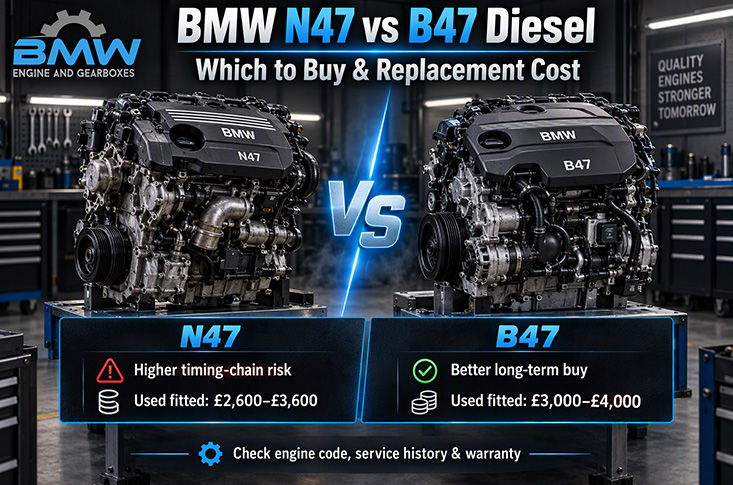
BMW N47 or B47 Diesel: Which Is the Safer Buy, Which Fails More, and What a Replacement BMW Engine Costs for Each
Written by Evie Parker | Reviewed by the BMW Engine and Gearboxes Editorial Team | Published by BMW Engine and Gearboxes | Updated 15 October 2026
Audience and use case: This UK automotive guide is for BMW diesel owners, used-car buyers, independent garages and customers sourcing a replacement engine. Use it to compare N47 and B47 reliability before buying a BMW, diagnose timing-chain symptoms, and decide between chain repair, a used engine and a reconditioned engine based on risk, vehicle value and fitted cost.
Short answer: For most UK used-BMW buyers, the B47 is the safer long-term choice because timing-chain failures are less common. Choose an N47 only when its service history is strong and there is documented evidence that the timing chain, crank pulley and swirl flaps have been checked or repaired.
Key takeaway: Buy the B47 when reliability and long-term ownership matter most. Consider an N47 when the car is well priced, the engine is still healthy and the major timing-related work is supported by invoices. If the engine has failed, compare repair and replacement costs before deciding: fitted prices in this guide range from £2,600 to £4,000 for a used engine and £3,800 to £4,600 for a reconditioned unit.
Who this guide is for and when to use it: This UK automotive guide is written for BMW diesel owners, used-car buyers, independent garages and engine-replacement customers comparing N47 and B47 2.0-litre diesel engines. Use it before buying a BMW 1 Series, 3 Series, 5 Series, X1 or X3; when investigating a cold-start rattle, timing-chain fault or loss of compression; or when deciding whether to repair the timing chain, fit a used engine or choose a reconditioned replacement. It supports purchase, diagnosis, repair-versus-replacement and fitted-cost decisions.
The quick comparison
The N47 is the older 2.0 diesel with the chain at the back of the engine, and it is the one that made BMW timing chains famous for the wrong reasons. The B47 is its replacement, with a redesigned timing drive and fewer failures. If you are comparing BMW engines and gearboxes before choosing between two cars, the B47 is the safer buy. If you already own an N47, it is not a bad engine — it simply needs watching.
Side by side
| Item | N47D20 | B47D20 |
| Production | 2007–2015 | 2014 onwards |
| Timing chain location | Rear of engine | Rear, revised design |
| Known faults | Chain, crank pulley, swirl flaps | EGR cooler, chain still possible |
| Used engine fitted | £2,600–£3,600 | £3,000–£4,000 |
| Reconditioned fitted | £3,800–£4,600 | £3,800–£4,600 |
| Our view | Reliable with attention | The better long-term buy |
Why the N47 has such a reputation
Because the chain sits at the back of the engine, against the gearbox. When it wears, the labour to replace it is significant, and when it fails, the damage is usually terminal. That design decision is the whole story of the N47's reputation, and it explains why owners get such varied quotes.
What actually fails on each engine?
| Fault | N47 | B47 |
| Timing chain wear | Common | Less common, still possible |
| Crank pulley failure | Known | Rare |
| Swirl flap wear | Common | Redesigned |
| EGR cooler cracks | Occasional | Known issue on some builds |
| Injector wear | At high mileage | At high mileage |
What does replacement cost for each?
| Route | N47 | B47 |
| Used engine fitted | £2,600–£3,600 | £3,000–£4,000 |
| Reconditioned engine fitted | £3,800–£4,600 | £3,800–£4,600 |
| Chain replacement only | £900–£1,600 | £900–£1,600 |
| Dealer short engine | £5,500+ | £5,500+ |
Which one should you buy?
Buy the B47 if you can afford it, because the revised timing design reduces the single biggest ownership risk on a modern BMW diesel. Buy the N47 if the car is otherwise excellent and the chain, pulley and swirl flaps have been addressed with paperwork.
What should you check on any BMW diesel?
- Chain condition, with evidence or a recent invoice.
- Oil change history at short intervals.
- EGR cooler condition on later builds.
- Injector leak-off at higher mileages.
- Fault codes read before purchase.
How do you look after either engine?
- Oil and filter every 6,000–8,000 miles.
- Correct specification oil, without exception.
- Investigate any cold rattle the same week.
- Keep the EGR and DPF systems healthy with regular runs.
- Keep the paperwork, because it is worth money at resale.
Frequently asked questions
Is the N47 a bad engine?
Not inherently, but it needs attention. The chain at the rear of the engine means that timing work costs more, and neglect is punished harder than on the B47.
How much is a replacement BMW diesel engine fitted?
A used replacement engine typically costs between £2,600 and £4,000, including fitting, while a reconditioned BMW engine generally costs between £3,800 and £4,600 fitted. The final cost of a replacement BMW 320d engine will depend on the exact engine code and model, as well as whether the vehicle is fitted with an N47 or B47 unit.
Can I swap an N47 for a B47?
No. Different ancillaries, mounts, sensors and software. Match the code that your car was built with.
Are B47 engines immune to chain problems?
No, but they are far less prone. Servicing discipline still matters, as it does on every diesel.
How long does the job take?
Three to six days for a used engine and one to three weeks for a reconditioned unit.
What does the timing chain layout mean in practice?
On both engines the chain sits at the rear of the block, against the gearbox. That single design decision has three consequences: the labour to replace a chain is high because the gearbox or engine must come out; a worn chain is harder to inspect; and a failure causes terminal damage before the driver hears anything beyond a brief rattle.
- Chain replacement requires major dismantling.
- Inspection is not a quick visual check.
- Failure causes valve and piston damage.
- Quotes vary widely because labour dominates.
- A documented chain replacement adds real value to the car.
Which BMW models use each engine?
| Engine | Common models | Years |
| N47D20 | 1 Series, 3 Series, 5 Series, X1, X3 | 2007–2015 |
| B47D20 | 3 Series, 5 Series, X3, X4 | 2014 onwards |
| N57 (3.0 six) | 530d, 535d, X5, X6 | 2008–2017 |
| B58 (3.0 petrol) | 340i, 540i, X3 M40i | 2015 onwards |
How do you check an N47 before buying?
- Cold start from stone cold, with the bonnet open.
- Listen for a rattle in the first two seconds.
- Read fault codes for cam correlation.
- Check the service history for oil intervals.
- Ask for any invoice relating to chain, pulley or swirl flap work.
- Review the GOV.UK MOT history for recurring emissions defects, warning lights and mileage inconsistencies.
What does an N47 chain replacement actually involve?
Gearbox out or engine out, depending on the model and the workshop's approach. New chain, guides and tensioner with updated components, new seals, fresh oil and filter, then a road test. It is a three to five day job done properly, and the labour is why the quote looks high.
Is a used B47 engine worth £3,000–£4,000 fitted?
On a car worth £10,000 or more and kept long term, yes. The B47 has the better reliability record, and a warrantied replacement protects the value of the car rather than simply restoring it.
How do you avoid chain problems on either engine?
- Oil and filter every 6,000–8,000 miles, not at longer intervals.
- Correct specification oil for the engine.
- No hard acceleration from cold.
- Any rattle reported and investigated the same week.
- Keep every invoice, because evidence matters at resale.
What should a BMW buyer ask before paying for a replacement engine?
Ask for the engine code, the warranty terms, what is included in the fitted price and the lead time, all in writing. On these cars the accessory and timing components are where the hidden costs sit, so the inclusion list matters as much as the headline figure.
Does an engine replacement need coding on a BMW?
Yes. Coding and adaptation are required, and on some models so is registering the replacement with the vehicle's electronics. A quote that omits coding is incomplete, and it usually means the final invoice will exceed the first one.
How do you inspect a rear-mounted chain without major dismantling?
You cannot, completely. What you can do is read cam correlation faults, listen to a genuine cold start, check oil pressure and review the history. Beyond that, the only certain inspection involves getting to the timing cover, which is a significant job in itself. That limitation is exactly why servicing discipline matters so much on these engines.
What does chain replacement involve on a 3 Series?
Gearbox out or engine out, depending on the workshop's approach and the model. New chain, guides and tensioner with updated parts, new seals, fresh oil and filter, then a road test with a code read. It is a three to five day job, and the labour is the reason the quote is high rather than the parts.
How does the N47 compare with BMW's petrol engines?
BMW's six-cylinder petrol engines, including the B58, have a better reputation for timing drive durability, and the failures that do occur are usually elsewhere: cooling, oil consumption or turbo. If you are choosing between a diesel and a petrol BMW of similar age, the petrol engine carries less timing risk.
What does the oil interval really do to these engines?
More than any other single factor. On both the N47 and the B47, the timing chain depends on clean, correct oil and stable oil pressure. Owners running 6,000-mile intervals consistently see less chain wear, less turbo wear and fewer injector problems than owners following longer schedules, and the cost of the extra oil changes is trivial against the cost of the repairs they prevent.
How do you decide between repairing the chain and replacing the engine?
If the engine still runs and the rattle is recent, repair the chain. If the engine has stopped, the chain has jumped and there are cam correlation faults with no compression, you are pricing an engine. Compression figures and a chain measurement decide it, and any workshop quoting an engine without those figures is guessing with your money.
Practical decision examples
- Running N47 with a recent cold-start rattle: arrange a chain inspection promptly. If the engine still has healthy compression and the timing has not jumped, the £900–£1,600 chain-replacement route may be more proportionate than replacing the complete engine.
- N47 that has stopped with timing faults and no compression: compare complete-engine quotes, because internal valve and piston damage can make a chain-only repair uneconomical.
- B47 fitted to a car worth £10,000 or more: a warrantied used engine at £3,000–£4,000 fitted may make sense when the rest of the vehicle is sound and the owner plans to keep it.
- Any used replacement engine: confirm the exact engine code, what the fitted price includes, coding requirements, lead time and written warranty before paying a deposit.
What should a buyer pay for a BMW diesel with a documented chain replacement?
Slightly more than for an equivalent car without, and it should be an easy sale. A documented chain replacement with updated components and a written warranty removes the single largest risk in owning an N47 or B47, and buyers who understand these engines know that.
Is there any way to avoid the rear-mounted chain problem altogether?
Buy a B47 rather than an N47, service it properly and treat any cold-start rattle as urgent. Those three choices reduce the risk to a manageable level, and they are the same choices we give members of our own family when they ask about buying a used BMW diesel.
Want to read or learn more about BMW engines?
- Reconditioned BMW 316d Engine Prices UK: Everything You Need to Know
- BMW X1 or X3 B47 Engine Problems — EGR, Timing and What It Costs
- BMW 530d and X5 N57 Engine Faults, Symptoms & Repair Costs
Categories
- Automotive News
- BMW
- saloon
- BMW 316d
- 7 series
- BMW 120d
- BMW 535d
- BMW 318d
- BMW 730D
- Bmw 530d
- BMW X6
- BMW 116i
- BMW 320d
- BMW M5
- BMW 5-Series
- BMW 325d
- SUV
- BMW 118D
- 1-series
- BMW 6-Series
- BMW 320i
- bmw 1 series
- BMW Mini
- BMW 116d
- Bmw Z series
- BMW X SERIES
- BMW 3-Series
- BMW 325
- BMW NEWS
- BMW 318i
- BMW i8
- BMW 330ci
- BMW engine
- BMW M power
- BMW 635d
- BMW 335d